
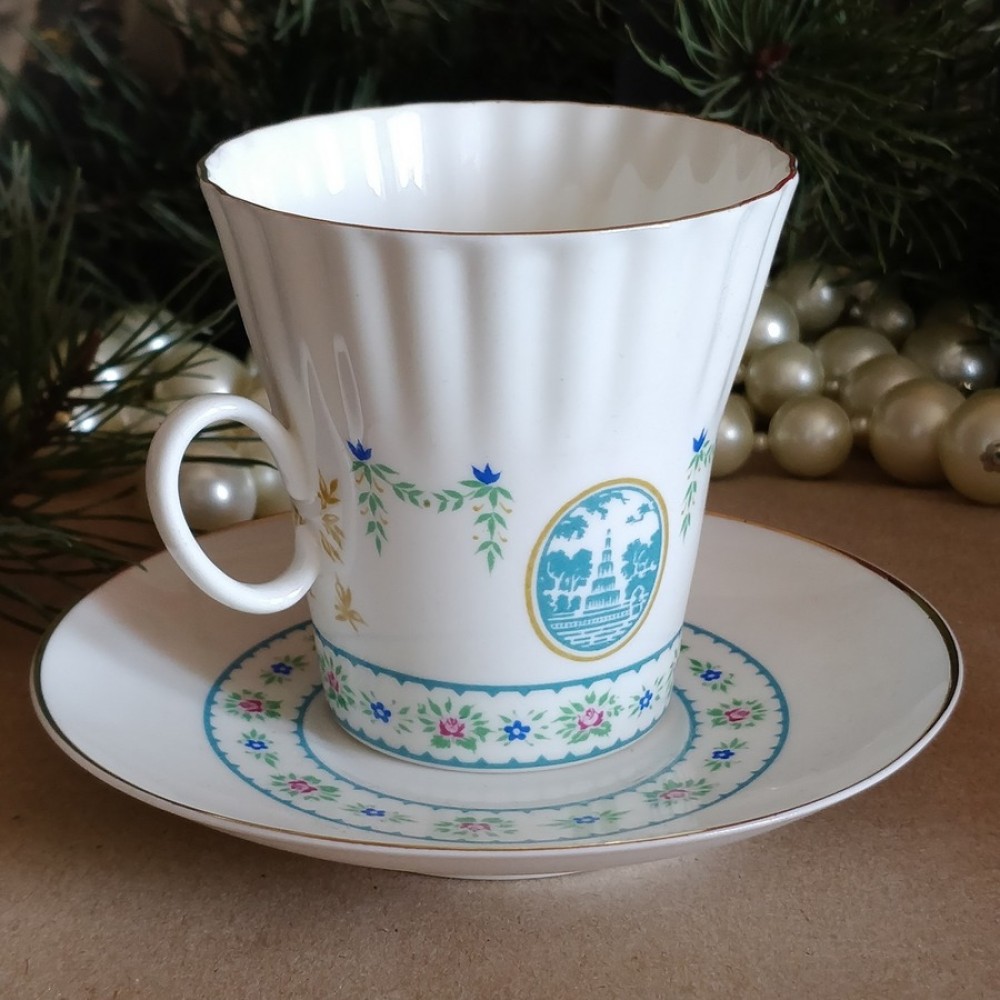
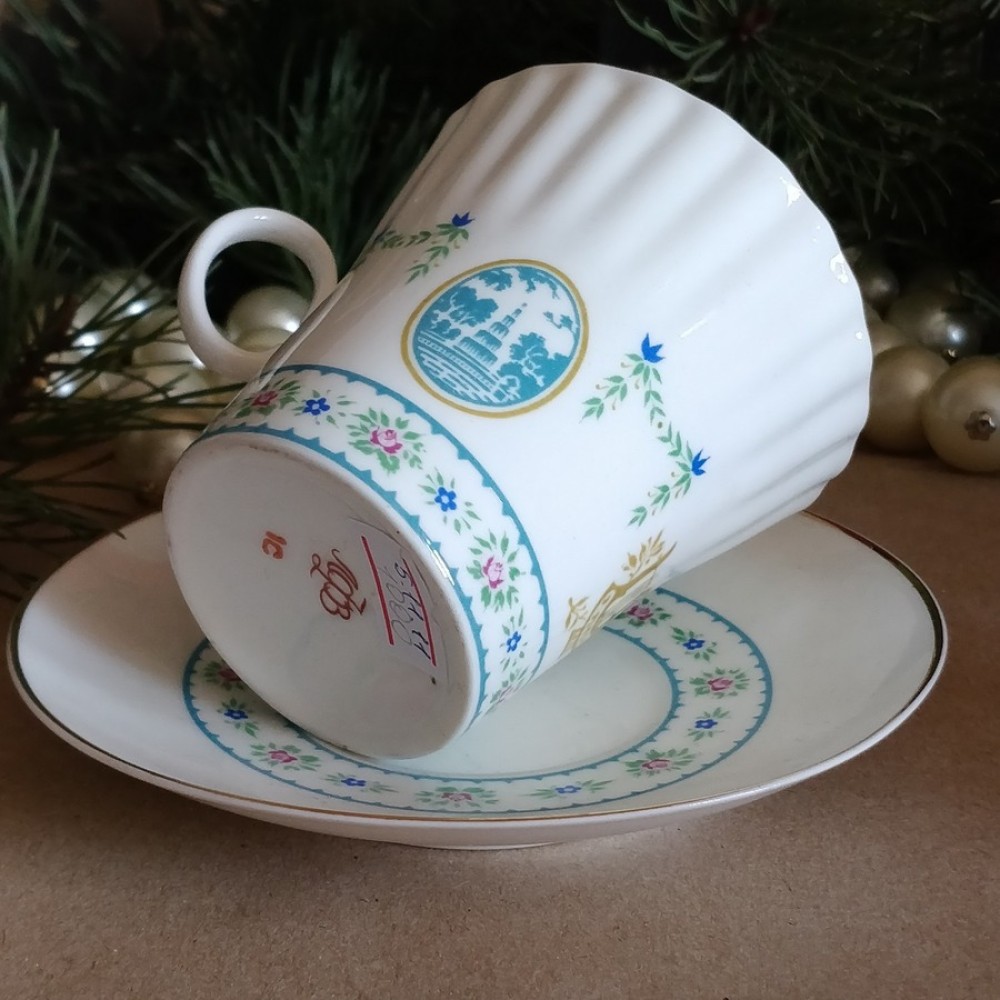
Vintage Bone China Tea Cup and Saucer "Golden Garlands" Lomonosov Made in USSR 1970
Bone china cup and saucer was made in the USSR at the Lomonosov Porcelain Factory. It bears the USSR Lomonosov Porcelain Factory hallmark on the bottom. Used, in excellent condition.
The item is hand-painted with 22-karat gold. Hand wash recommended.
Genuine Article - 100% Guaranteed.
Hand wash recommended.
Capacity 5.24 fl.oz/155ml;
Cup measures: height 6.5 cm (2 ½").
Saucer measures: Diameter 12 cm (4 ¾")
Bone china, the paste of which contains calcium phosphate (animal bone ash) imparting whiteness and quality to the material, was first produced by Englishman Thomas Fray in 1749. The Wedgwood ceramics works manufactured such items and for many years remained the sole global supplier. It is no surprise they were reluctant to publicize their production methods. English bone china, however, proved somewhat thick and did not produce a desirable light sound.
The production of bone china necessitated changes throughout the entire manufacturing process, from preparing the liquid casting paste to the firing procedure. In addition to clay, kaolin, feldspar, and quartz, pre-fired bonemeal was added, resulting in a snow white paste. To preserve the thin and fragile form, firing occurred similarly to stoneware: initially at high temperature, then after glazing, at 100 degrees less. The porcelain glaze application utilized a spray technique, applying an extremely thin layer – as Vinogradov noted in his records, porcelain glaze should never exceed the thickness of two sheets of paper.
The characteristics of this new material were highly valued by leading modellers such as Eduard Krimmer, Anna Leporskaya and Vladimir Semyonov. The innovative cup and service shapes they created emphasized the thinness, transparency, and whiteness of the enamel while maintaining classical proportions and clear, pure contours. Later Tatiana Linchevskaya, Nina Slavina and E. Yeropkina also worked with bone china. This new material and its technical possibilities expanded creative scope significantly. The ceremonial set "White Flower," resembling fully opened white campanulas with emphatically swept edges, designed by Slavina, exemplifies this. This work, along with other pieces by Slavina, received the silver medal of the Academy of Arts of the USSR and is now in the collection of the Museum of Russian Applied Arts and the factory museum. Decoration by Alexei Vorobyevski, Tamara Bespalova-Mikhalyova, Mikhail Mokh and Inna Olevskaya imbued these bone china pieces with an air of costly elegance.
Their works immediately achieved collector's item status, securing a place as prestigious gifts.
The primary objective remained ensuring bone china would also become items of mass consumption and production. To this end, a new production unit was established at the Leningrad factory exclusively for bone china. All installations for this, including technical innovations, were developed within the factory itself. Subsequently, bone china production based on the Leningrad process was extended, with factory assistance, to Lithuania and the Bulgarian city of Vidin.
FB
- Product Code: 8094
- Availability: In Stock
-
$24.99