
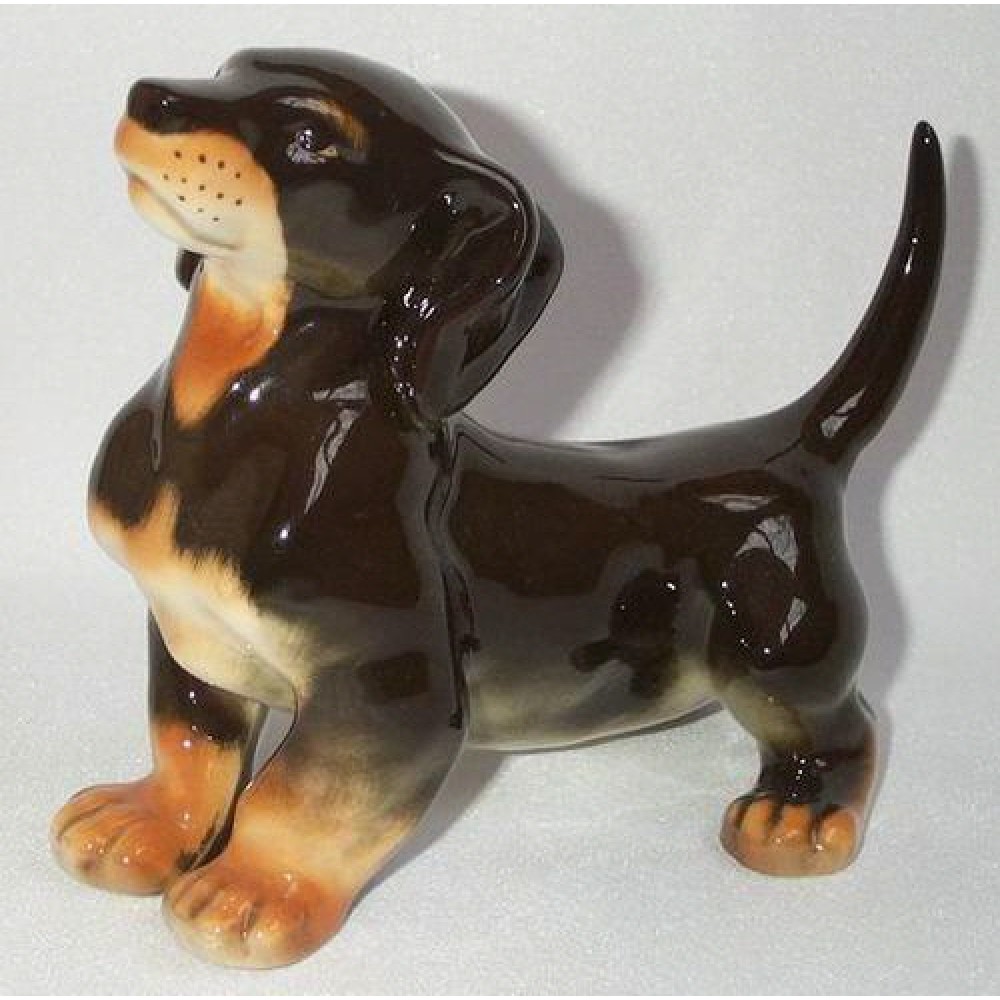
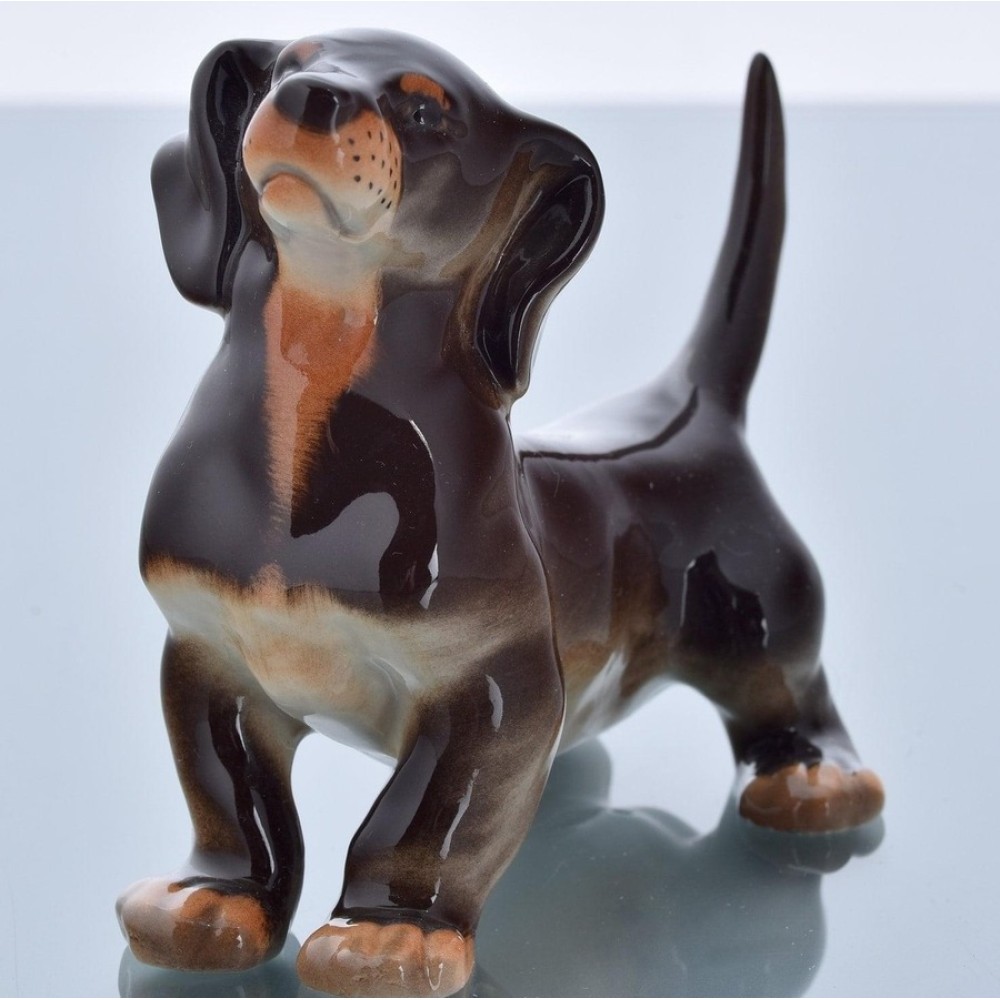
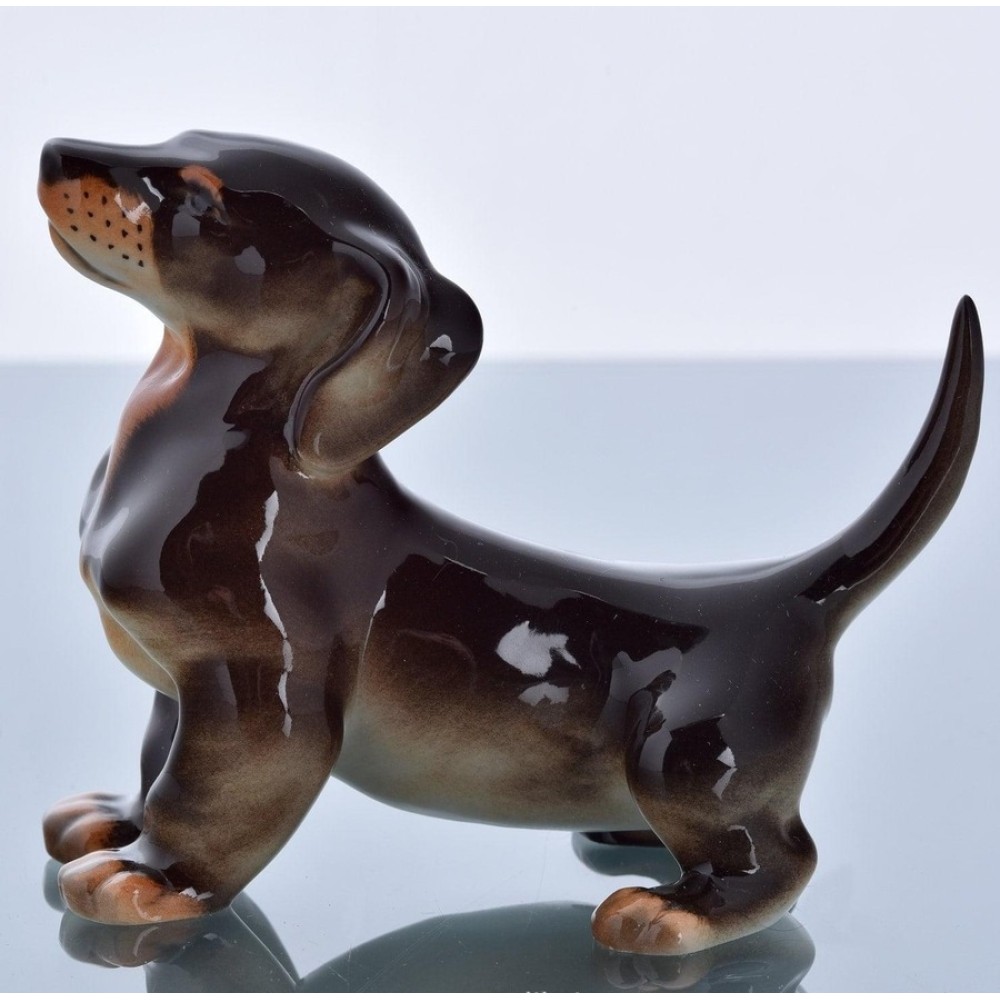
It has the Lomonosov Porcelain Factory (LFZ) logo on the bottom. It's 4 1/2 inch. tall and 5 inch. long. It has the Lomonosov Porcelain Factory (LFZ) logo on the bottom. Brand new, excellent condition, the export quality.
The Dachshund breed of dog has been seen in illustrations that are dated back to the 15th century. It is known that this breed was created for a specific purpose. The German foresters had to find a way to control a varmint known as the badger, from ruining their master's hunting parties. The badger was a nasty tempered predator that had its den underground. What the foresters were looking for was a courageous dog that had a body slender enough to fit down the burrow, sufficiently lithe to manuever into the den, and tenacious and strong enough to fight the badger to the death. What they came up with was a remarkable dog that defined form following function. The word dachs means badger. The word hund means dog. So the word Dachshund is interpreted to mean badger dog. The Germans also refer to this breed as Teckel, which is actually Old German for Dachshund.
The Dachshund that we recognize today is a mixture of hounds and terriers. This crossing was accomplished starting in the 17th century, when a formal breeding program could be recognized. For centuries prior to that, historians tell us that goods and people were moving and flowing across the borders of European countries. French hounds could be found in Germany. It is thought that the French Braque (a small pointer type) and the Pinscher were used to develop the smooth-haired Teckel. In the early part of the 18th century, this German Teckel was described as being a peculiar low-crooked species. Late in the 18th century, the French Revolution caused many of the nobility to flee France to go to Germany. With them they took their favorite hunting dogs, some of these being the French Bassets. The German Teckel and the French Bassets were crossed and the puppies that resulted from this mix became Dachsbracke if they possessed long legs and Dachshunds if they had short legs, short ears and pointed muzzle.
At first there was the smooth-coated and the longhaired varieties of Dachshund. The wirehaired Dachshund is of more recent history. Also there are two sizes of Dachshund, the Miniature (less than 11 pounds) and the Standard (about 18 - 20 pounds). In Germany there is the third size, Kaninchenteckel. The Germans use chest measurements taken at a certain age to determine the size of the Dachshund.
Although this breed started out to be used for eliminating badgers, the German foresters discovered this dog was an excellent hunter of fox, rabbit, and for finding wounded deer. In packs, the Dachshund could also hunt wild boar. The breed turned out to be far more versatile than had been originally planned.
The English eventually became quite interested in this dog and imported it to the British Isles. The development of the breed there caused a divergence of type, as compared to the European, specifically the German, Teckel. The length of the dog became greater, the dog weighed more, and the legs got shorter. The forechest also became considerably larger. It was the opinion of the German Teckel breeders that the English rendered the breed incapable of doing the work it was originally bred for.
In the early 19th century, Dachshunds came to the United States with German immigrants. There were imports brought from England as well. The breed became very popular in the U.S. The American Kennel Club began to register Dachshunds in 1885. The Dachshund Club of America was organized in 1895.
World War I had a terrible impact on the Dachshund breed, especially in Great Britain and in the United States. People turned their hatred of anything German on this breed of dog and the result was the Dachshund numbers dwindled significantly. After the war was over, U.S. breeders were able to slowly rebuild the breed again. The Second World War did not have as significant impact as W.W.I.
Beautiful Dachshund Lomonosov porcelain figurine
- Product Code: 5906
- Availability: In Stock
-
$15.00